Paper Engine
ExperimentBoard Game Mechanics Recommendation
Data cleaning machine for Non-technical person
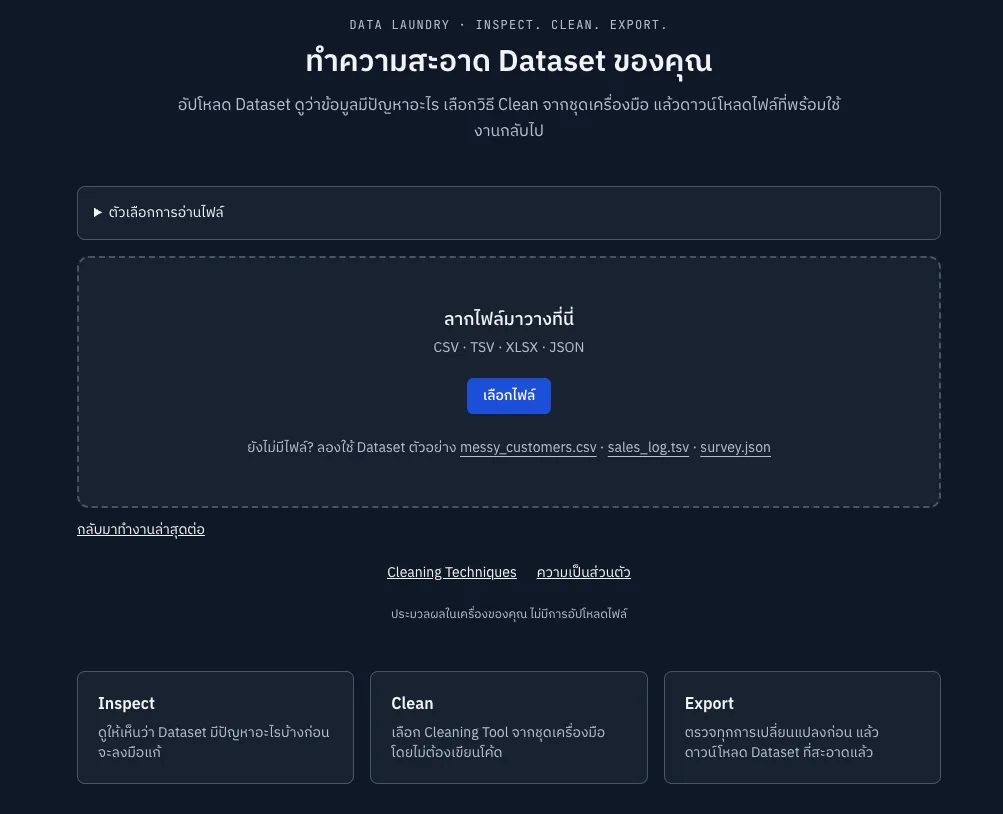
Data Laundry is a web application for inspecting and cleaning datasets without writing Python or a cleaning script.
Upload a CSV, TSV, XLSX or JSON file, see what is wrong with the data, choose fixes from a set of cleaning tools, compare before and after, and download a dataset that is ready to use — all in one workflow.
Before data goes into analysis, a report or another system, we keep spending time on the same chores: removing duplicates, handling missing values, fixing date formats, trimming whitespace, or merging values that were written differently into one standard.
None of it is complicated, but it takes time and comes back with almost every new file.
Excel or Google Sheets can fix the data, but the changes are hard to audit and hard to repeat. Python and data engineering tools need far more coding skill than everyday file cleaning calls for.
So the problem is not only how to clean data, but how to make cleaning fast, reviewable and repeatable without starting over every time.
Data Laundry is built around Inspect. Clean. Export.
After an upload, it starts with a data health check — missing values, duplicate rows, inconsistent formats, likely outliers and a profile of each column — summarized as a Health Score with suggestions on what to look at.
You choose a cleaning tool, configure it and preview the result before adding each step to the pipeline. Nothing is changed automatically without your confirmation.
Every step can be toggled, reordered, edited or removed, so you can experiment without touching the original data. When the result looks right, review the Before/After and download it as CSV, XLSX or JSON.
Pipelines you use often can be saved as a Recipe and applied to the next batch of files, without remembering or redoing every step.
Data Laundry rests on five principles: Simple, Transparent, Modular, Reversible and Private by Default.
Datasets are processed inside the browser, so the data never leaves your machine, and heavy work runs in a Web Worker so the interface stays responsive during analysis and processing.
The cleaning pipeline is the single source of truth for every change. The original data is never edited directly, and you can undo, reorder or try different cleaning approaches before exporting.
The workspace supports CSV, TSV, XLSX and JSON including Thai encodings, large datasets through a Sampling Mode, saving work in the browser, and a library of cleaning techniques that explains the idea, the caveats and example code for anyone who wants to reuse the same approach.
Data Laundry is open to try at datalaundry.lifebugs.dev. The core workflow — Upload, Inspect, Clean, Review and Export — works end to end, with no sign-in required.
It supports dozens of cleaning tools, saving pipelines as Recipes and in-browser processing. Phase 2 is in progress, adding more reuse, outlier checks, a Cleaning Report, Dataset History and further technique documentation.